
How Should Companies Choose the Right BESS System Power?
- 7 days ago
- 3 min read
Battery Energy Storage Systems (BESS) are becoming an increasingly important part of modern energy infrastructure for businesses. However, one of the most important questions before starting a project is — how should companies choose the right BESS system power?
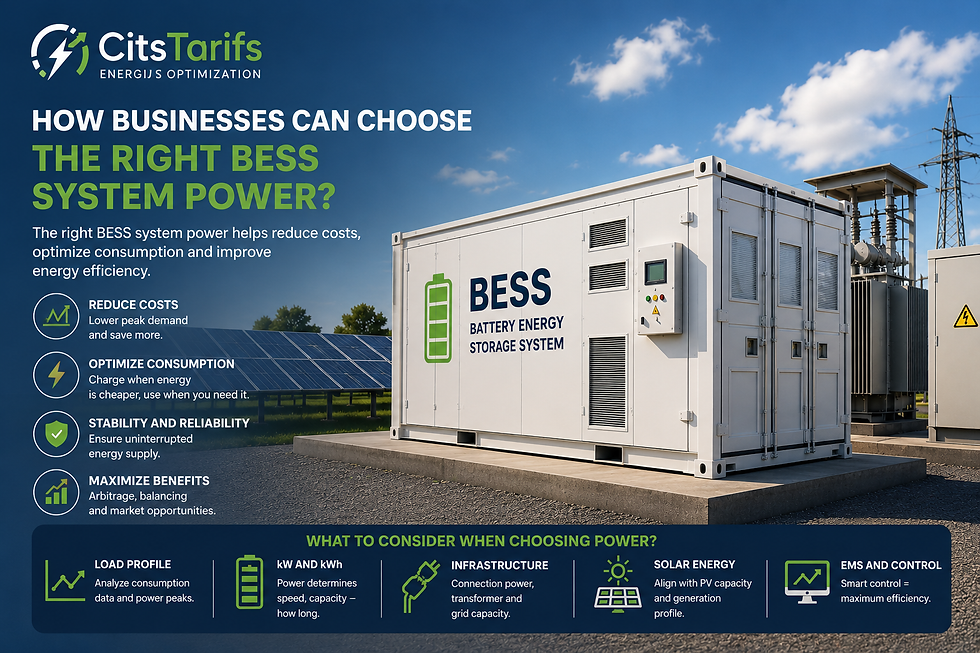
Selecting the correct BESS system power is critical for optimizing electricity costs, reducing peak demand and improving overall infrastructure efficiency. An incorrectly sized system can significantly reduce project performance and increase investment costs.
Why Is BESS System Power So Important?
BESS system power determines how quickly the system can:
charge
discharge
compensate electrical loads
react to energy consumption changes
System power directly impacts:
energy optimization efficiency
peak demand reduction
balancing potential
energy arbitrage performance
infrastructure stabilization
Understanding the Difference Between kW and kWh
One of the most common misunderstandings in BESS projects is the difference between:
power (kW / MW)
capacity (kWh / MWh)
BESS system power indicates:
how quickly the system can deliver or absorb energy
Meanwhile, capacity determines:
how long the system can sustain a specific power level
For example:
a 1 MW / 2 MWh system can theoretically provide 1 MW for approximately 2 hours
Understanding this relationship is essential for selecting the right BESS configuration.
Electricity Consumption Analysis
Choosing the correct BESS system power requires detailed electricity consumption analysis.
It is important to evaluate:
average electricity consumption
maximum demand peaks
load dynamics
daily consumption profiles
solar panel generation
infrastructure loading
Load profile analysis helps determine the optimal system power for the facility.
Peak Demand Optimization
Many companies implement BESS systems specifically to reduce peak demand charges.
In these situations, companies should evaluate:
how high the demand peaks are
how long they last
how often they occur
A system with insufficient power may fail to compensate for peak loads effectively, while an oversized system may unnecessarily increase investment costs.
Solar Panels and BESS Systems
In facilities with solar panels, BESS system power is often adjusted according to solar generation capacity.
This helps companies:
store excess solar energy
optimize self-consumption
reduce electricity exports to the grid
stabilize infrastructure loading
Properly selected system power improves the utilization of generated solar energy.
Balancing Markets and Energy Arbitrage
If a company plans to use a BESS system for:
balancing services
energy arbitrage
frequency regulation
then system response capability and power become critically important.
Projects should evaluate:
charging and discharging speed
response times
infrastructure capacity
EMS control logic
The right BESS system power allows businesses to maximize opportunities in electricity markets.
EMS and System Control
Modern BESS systems use:
EMS platforms
SCADA systems
dynamic algorithms
real-time analytics
This allows companies to:
optimize charging cycles
stabilize energy flow
react to market prices
improve infrastructure utilization
Proper EMS configuration significantly affects overall system power efficiency.
Why Is Professional Analysis Important?
Every company has different:
electricity consumption patterns
infrastructure loading
operational schedules
grid connection capacity
solar generation levels
That is why professional load and infrastructure analysis is essential when selecting the right BESS system power.
CitsTarifs specialists help companies:
analyze electricity consumption
model load profiles
select the most suitable system power
optimize infrastructure solutions
integrate EMS and control systems
This ensures efficient and economically optimized long-term BESS system operation.
Conclusion
Selecting the correct BESS system power is one of the most important factors for successful project implementation.
A properly configured system helps companies:
optimize electricity costs
reduce peak demand
stabilize infrastructure
improve solar energy utilization
optimize energy management
That is why more and more companies are choosing a professional approach to selecting the right BESS system power and optimizing long-term energy infrastructure efficiency.


Comments